Last updated Sep 3, 2026.
Muse Glimmer Pricing: API Cost per 1M Tokens
9 minutes read

Shubham Tribedi
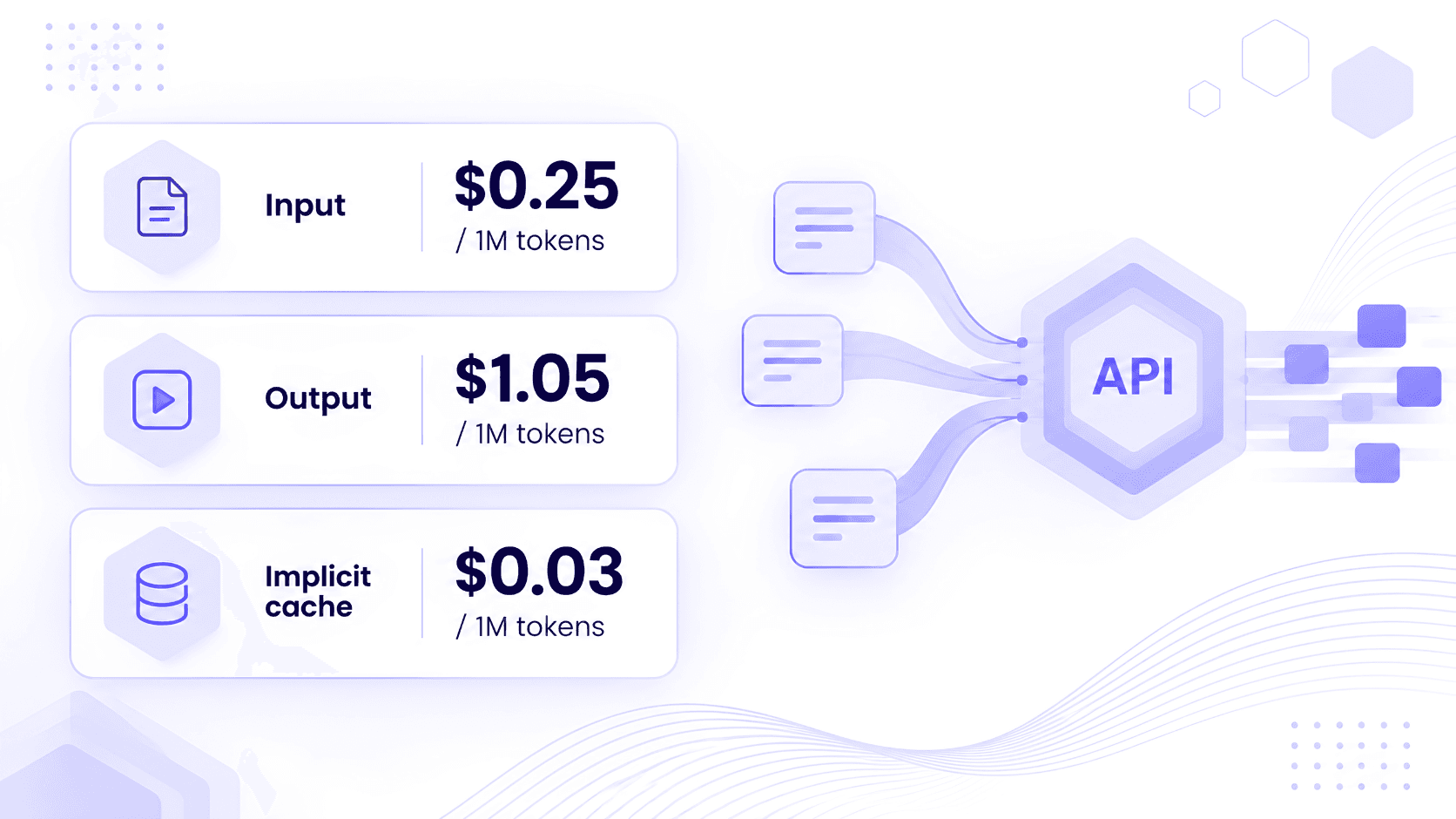
Quick answer: Muse Glimmer costs $0.25 per 1M input tokens and $1.05 per 1M output tokens on Qubrid AI, with implicit cached input at $0.03 per 1M tokens. That is a blended rate of roughly $0.176 per 1M tokens at a standard 7:2:1 ratio, below the $0.23 median Artificial Analysis tracks across providers serving this model.
Muse Glimmer rate card
Pay-as-you-go, no minimum commitment, no reserved capacity requirement.
Token type | Qubrid price |
|---|---|
Input | $0.25 / 1M tokens |
Output | $1.05 / 1M tokens |
Implicit cache | $0.03 / 1M tokens |
Model string: meta-models/Muse-Glimmer-30B. Endpoint: https://platform.qubrid.com/v1.
Output is priced at 4.2x input, a narrower ratio than most reasoning models carry, which matters because Muse Glimmer is a reasoning model whose thinking tokens bill as output.
How that compares to the tracked market
Artificial Analysis tracks a median of $0.325 per 1M input and $1.35 per 1M output across providers serving Muse Glimmer, for a blended rate of $0.23 per 1M tokens at a 7:2:1 ratio.
Qubrid AI | Tracked median | |
|---|---|---|
Input | $0.25 | $0.325 |
Output | $1.05 | $1.35 |
Blended (7:2:1) | $0.176 | $0.23 |
Roughly 23% below the tracked median on a blended basis.
The 88% cache discount, and why it matters more here
Cached input at $0.03 against $0.25 uncached is an 88% discount, among the steeper implicit-cache discounts on any model.
That discount does disproportionate work on this particular model, because of what Muse Glimmer is for. Agent loops re-send a large, stable prefix on every single turn: the Reasoning strength directive, system instructions, tool schemas, few-shot examples, accumulated conversation. Identical, call after call, for the length of the session.
Worked example
An agent runs a 12-turn session with a 40,000-token system prompt and tool schema that never changes:
Without cache hits: 12 × 40,000 × $0.25 / 1,000,000 = $0.120
With cache hits after turn one: (40,000 × $0.25 + 440,000 × $0.03) / 1,000,000 = $0.023
An 81% reduction on the static portion of input spend, before counting the actual conversation.
How to earn cache hits
Order your prompt by descending stability:
Reasoning strength: highSystem instructions
Tool and function schemas
Few-shot examples
Documents that persist across the session
Conversation history
The current user message
The common and expensive mistake is injecting a timestamp, session ID or user name near the front. One variable token at position two means you never earn a cache hit for the entire session. Move it to the end.
There is a happy accident in this model's design worth noting: because reasoning strength is set through the system prompt rather than an API parameter, it sits naturally at the front of the stable prefix. The setting that controls your reasoning cost is itself cached.
Monthly cost estimates
Assuming no cache hits, so treat these as ceilings:
Monthly volume | Input cost | Output cost | Total |
|---|---|---|---|
5M in / 1M out | $1.25 | $1.05 | $2.30 |
50M in / 10M out | $12.50 | $10.50 | $23.00 |
250M in / 50M out | $62.50 | $52.50 | $115.00 |
1B in / 200M out | $250.00 | $210.00 | $460.00 |
Apply your real cache hit rate to the input column and these drop substantially. On agentic workloads with a stable prefix, a 70% hit rate takes the input column down by roughly three quarters.
Reasoning strength is a cost control
Muse Glimmer supports four reasoning levels: low, medium, high and xhigh. Meta recommends high or xhigh for complex problem solving, coding and agentic tasks.
Reasoning tokens bill as output at $1.05 per 1M. Setting the level deliberately rather than defaulting to high on everything is the most direct lever you have.
Workload | Reasoning strength | Effect on cost |
|---|---|---|
Classification, routing, extraction, short summarisation |
| Lowest output spend |
Chat, RAG answering, simple lookups |
| Modest reasoning, most of the quality |
Coding, tool use, agentic workflows |
| Meta's recommendation for this class of work |
Hard multi-step problems, long-horizon planning |
| Reserve for a fraction of traffic |
One thing working in your favour: Artificial Analysis measured Muse Glimmer generating 48M output tokens across its Intelligence Index, exactly at the class median, and rates it fairly concise. Unlike some reasoning models that quietly triple your output bill, this one reasons efficiently.
Remember that the setting lives in the system prompt as Reasoning strength: <value>, not in an API parameter. A reasoning_effort argument carried over from another model family is silently ignored, which means you are paying for whatever the default does.
API versus self-hosting: an unusually close call
For most models this comparison is one-sided. Muse Glimmer is the exception, because Meta built it specifically to run on hardware you might already own, and released everything under Apache 2.0: BF16 weights, two 4-bit quantized variants, the DFlash drafter and the perception encoder.
So the honest answer here is that self-hosting is a real option, and the decision turns on details rather than on obvious economics.
What the hardware actually costs you
Meta compressed the language model to approximately 4-bit precision, shrinking it to under 20 GB, leaving headroom for the KV cache, the perception encoder and the DFlash drafter to run together inside a 24GB or 32GB envelope.
Build | Target hardware | Measured degradation |
|---|---|---|
Full precision (BF16) | 64GB VRAM | - |
K-Quant-Dynamic | 32GB VRAM | 0.2% |
K-Quant-17GB | 24GB VRAM | 1.0% |
Degradation was averaged across accuracy metrics on 15 common benchmarks. It is small, and Meta validated it carefully. But note what the table implies: running locally means running quantized, because 64GB of VRAM is not consumer hardware. Hosted serving does not carry that constraint.
Per NVIDIA's technical blog, the model fits within a single GPU's VRAM with no sharding, CPU offloading or external endpoints, across GeForce RTX 5090, DGX Spark, DGX Station and Jetson platforms.
The number that decides it
Meta's local throughput figures look excellent:
Hardware | Baseline tok/s | With DFlash | Speedup |
|---|---|---|---|
NVIDIA RTX 5090 | 74.9 | 233.4 | 3.1x |
Apple M5 Max | 26.6 | 50.2 | 1.8x |
Apple M4 Max | 23.7 | 37.8 | 1.5x |
Then read the footnote. These were measured at batch size 1 with greedy decoding.
That is one request at a time. A single consumer GPU serving ten concurrent agent sessions does not deliver ten times 233 tokens per second, it degrades sharply. Server-side continuous batching is what makes concurrent throughput work, and it is not something one card under a desk does well.
If your deployment is one user with one agent, the local numbers are real and excellent. If it is a product serving many users, they describe a benchmark rather than your workload.
When each option wins
Self-host when: you are building a genuinely on-device agent where the point is that data never leaves the machine, you have air-gap or residency requirements, traffic is single-user or low-concurrency, or you already own suitable hardware sitting idle.
Use the API when: you need concurrency, you want full-precision serving rather than a 4-bit build, you are deploying into CI pipelines, serverless functions or container fleets that cannot host a 20GB model, you need consistent behaviour across a team rather than ten slightly different local setups, or you are still evaluating whether the model fits at all.
At $0.25 input and $1.05 output, a workload running 50M input and 10M output tokens a month costs about $23. That is below the monthly cost of most GPU rentals capable of serving the model with any concurrency, before engineering time and before idle capacity.
If dedicated hardware turns out to be right for you, Qubrid also provides on-demand GPU compute and on-premises AI appliances, so the decision does not require changing vendors.
Frequently asked questions
How much does Muse Glimmer cost per 1M tokens? $0.25 per 1M input tokens and $1.05 per 1M output tokens on Qubrid AI, with implicit cached input at $0.03 per 1M tokens.
What is the blended price of Muse Glimmer? Roughly $0.176 per 1M tokens at a standard 7:2:1 cache-hit, input, output ratio, against a $0.23 median tracked across providers by Artificial Analysis.
How much does cached input cost on Muse Glimmer? $0.03 per 1M tokens, an 88% discount against uncached input. On multi-turn agent workloads with a stable prefix, that typically removes around 80% of input spend.
Are reasoning tokens billed separately? No, they bill at the output rate of $1.05 per 1M tokens. Artificial Analysis rates the model fairly concise at 48M output tokens across its Intelligence Index, exactly at the class median.
Is there a free tier for Muse Glimmer? Qubrid is pay-as-you-go with no minimum commitment, so you can evaluate at whatever volume your test needs. The weights are also Apache 2.0 if you prefer to run it yourself at hardware cost.
Is the API cheaper than self-hosting Muse Glimmer? It depends on concurrency more than on volume. For single-user local agents, self-hosting is genuinely competitive and is what Meta designed for. For anything serving concurrent users, the batch-size-1 local throughput figures do not carry over and the API wins.
What hardware do I need to run Muse Glimmer locally? 24GB of VRAM for the K-Quant-17GB build at 1.0% degradation, 32GB for K-Quant-Dynamic at 0.2%, or 64GB for full precision. It fits a single GPU with no sharding.
Does running Muse Glimmer locally reduce quality? Slightly, and Meta published the numbers: 0.2% average degradation for the 32GB build and 1.0% for the 24GB build, measured across 15 common benchmarks. Full precision needs 64GB of VRAM, which hosted serving can provide and a laptop cannot.
Does the price change with context length? No. The rate is flat across the 131,072-token context window. Longer prompts cost more because they contain more tokens, not because of a tier change.
How do I reduce my Muse Glimmer bill? Two levers. Order your prompt so invariant content comes first and earn the 88% cache discount, and set Reasoning strength deliberately rather than leaving every request at high.
Start building
meta-models/Muse-Glimmer-30B is live on Qubrid AI at $0.25 per 1M input tokens.
Generate an API key at platform.qubrid.com
Point your OpenAI SDK at
https://platform.qubrid.com/v1Set
model="meta-models/Muse-Glimmer-30B"Put
Reasoning strength: highat the top of your system prompt
Qubrid AI serves 60+ open-source models behind one OpenAI-compatible API, alongside on-demand GPU compute and on-premises appliances.