
Last updated Jul 8, 2026.
Grok 4.5 vs GLM-5.2: What xAI's Own Benchmarks Reveal About Open-Source AI Models (July 2026)
8 minutes read

Shubham Tribedi
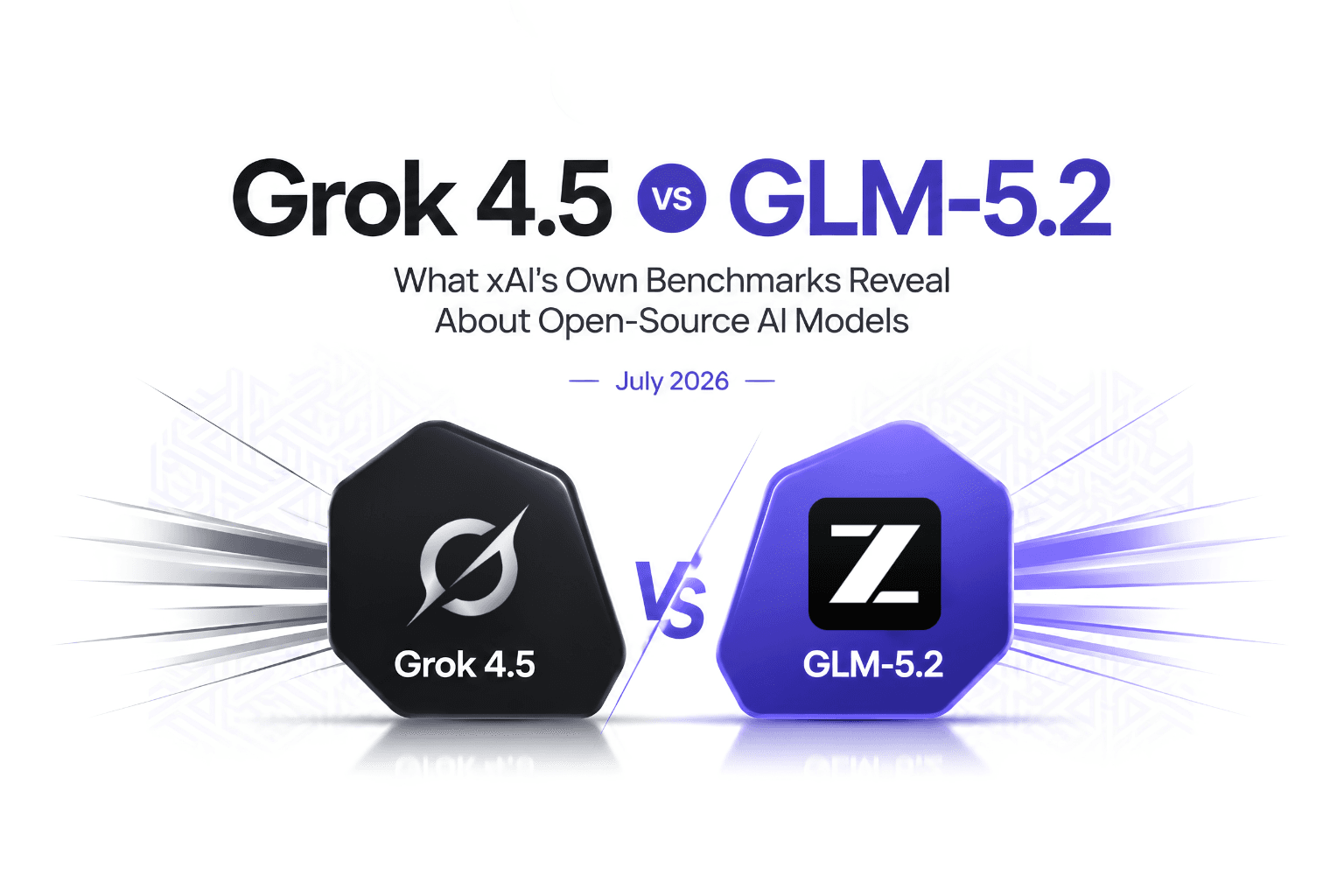
xAI released Grok 4.5 on July 8, 2026, its most capable model to date, built for coding, agentic tasks, and knowledge work. The launch itself made headlines. But for teams evaluating open-source AI models, the most interesting detail was in xAI's own benchmark charts: GLM-5.2, an MIT-licensed open-weight model, scored within 2.6 points of Grok 4.5 on SWE Bench Pro, ahead of GPT 5.5.
In this post we break down the published numbers, look at where the open-source comparison genuinely holds up (and where it doesn't), and walk through the practical economics of self-hosting GLM-5.2 versus paying per token for a closed API.
What is Grok 4.5?
Grok 4.5 is xAI's new flagship model, trained across tens of thousands of NVIDIA GB300 GPUs and developed alongside Cursor. Key facts from the official announcement:
Pricing: $2 per million input tokens, $6 per million output tokens
Speed: served at roughly 80 tokens per second
Token efficiency: ~15,954 average output tokens per SWE Bench Pro task, about 4.2x fewer than Claude Opus 4.8's 67,020
Training: heavy reinforcement learning across hundreds of thousands of tasks, centered on multi-step software engineering, with asynchronous rollouts across the GPU fleet
Availability: xAI API, Grok Build, and Cursor; EU availability expected mid-July
Weights: not publicly released
The token-efficiency claim deserves a note: xAI is arguing that intelligence per token matters as much as intelligence per benchmark point. A model that solves the same task in a quarter of the tokens is effectively 4x faster and 4x cheaper at the same per-token price. This framing is likely to shape how all models get compared going forward, including open-source ones.
What is GLM-5.2?
GLM-5.2 is Z.ai's (Zhipu AI) flagship open-weight model, released June 16, 2026 under the MIT license:
Architecture: ~750B-parameter mixture-of-experts (MoE) with roughly 40B active parameters per token (256 routed experts, 8 activated per token)
Attention: DeepSeek-style sparse attention (DSA) with MLA KV-cache compression, plus the IndexShare mechanism that cuts per-token compute at very long context
Context window: 1M tokens, with up to 128K-token outputs
License: MIT. Weights freely downloadable from Hugging Face, usable commercially, fine-tunable
Footprint: ~1.37 TB in BF16, ~744 GB in FP8, ~459 GB in community NVFP4 quantizations
Because only ~40B of the ~750B parameters activate per token, GLM-5.2 delivers large-model quality at a fraction of the inference compute of a dense model the same size. It is the same architectural bet behind DeepSeek and Kimi models.
Grok 4.5 benchmark results: the full picture
xAI's launch page reports four coding/agentic benchmarks. We're showing all of them, because the picture is more nuanced than any single chart.
SWE Bench Pro (resolve rate):
Model | Score | Open weights? |
|---|---|---|
Claude Fable (max) | 80.4% | No |
Claude Opus 4.8 (max) | 69.2% | No |
Grok 4.5 | 64.7% | No |
GLM-5.2 | 62.1% | Yes (MIT) |
GPT 5.5 (xhigh) | 58.6% | No |
Terminal Bench 2.1:
Model | Score |
|---|---|
Claude Fable (max) | 84.3% |
GPT 5.5 (xhigh) | 83.4% |
Grok 4.5 | 83.3% |
Claude Opus 4.8 (max) | 78.9% |
DeepSWE 1.0 (run within each model provider's own harness):
Model | Score |
|---|---|
Claude Fable (max) | 66.1% |
GPT 5.5 (xhigh) | 64.3% |
Grok 4.5 | 62.0% |
Claude Opus 4.8 (max) | 55.8% |
DeepSWE 1.1 (run independently by DataCurve on the mini-swe-agent harness):
Model | Score |
|---|---|
Claude Fable (max) | 70% |
GPT 5.5 (xhigh) | 67% |
Claude Opus 4.8 (max) | 59% |
Grok 4.5 | 53% |
GLM-5.2 | 44% |
Three honest takeaways from the full data
1. The open-source gap has nearly closed on some benchmarks, but not all. On SWE Bench Pro, GLM-5.2 sits 2.6 points behind a frontier model announced the same week. On the independently-run DeepSWE 1.1, the gap to the leaders is much wider (44% vs 70%). Anyone claiming open source has "caught up" across the board is overreading one chart; anyone dismissing open models is ignoring another.
2. Benchmark methodology visibly moves scores. Grok 4.5 scores 62% on DeepSWE 1.0 within provider-run harnesses, and 53% on DeepSWE 1.1 under an independent common harness. Neither number is wrong; they measure different setups. The practical lesson for any evaluation: check who ran the benchmark, with what harness, and wherever possible test on your own workload before committing.
3. Agent harness quality is part of the product. The gap between provider-harness and common-harness results suggests that a meaningful share of "model capability" on agentic benchmarks lives in the scaffolding around the model. Open-source deployments control that scaffolding fully, which is an underappreciated advantage of self-hosting.
Cost comparison: Grok 4.5 API vs self-hosted GLM-5.2
Grok 4.5: $2 per million input tokens, $6 per million output tokens. Zero infrastructure. A workload processing 1B input + 200M output tokens monthly costs about $3,200/month.
GLM-5.2 self-hosted: third-party benchmarks (SemiAnalysis InferenceX) measured large MoE models of this class on 8x NVIDIA B200 nodes at roughly $0.13–0.29 per million total tokens at high utilization, using FP4 weights and FP8 KV cache. The same 1.2B-token monthly workload lands around $160-350 in compute, if the node stays busy.
That "if" is the entire decision:
High, steady traffic (internal copilots, batch processing, agents running around the clock): self-hosting wins by an order of magnitude, and your data never leaves your environment.
Spiky or low traffic: an idle GPU node bills the same as a busy one. Closed APIs, or on-demand GPU rental billed hourly, win until utilization is high enough.
Data-sensitive workloads (legal, healthcare, finance, government): self-hosted open weights may be the only viable option regardless of cost.
There is also a middle path worth knowing about: GLM-5.2 via an open-model API. Because the weights are open, providers (including Qubrid AI) serve GLM-5.2 behind a per-token API, so you get the convenience of an API without committing to a closed model. If usage grows, you can move the exact same model onto dedicated GPUs later, with no migration risk. That optionality simply does not exist with closed models.
How to run GLM-5.2 yourself
The current serving recipe for GLM-5.2 on NVIDIA Blackwell hardware:
Full precision path: FP8 checkpoint (~744 GB) on an 8x B200 node (1,440 GB HBM), tensor parallel 8, SGLang v0.5.10+
Quantized path: community NVFP4 checkpoints (~410–459 GB) fit on 4 GPUs, freeing the other half of the node for a second replica or longer context. Requires SGLang v0.5.13.post1+ or vLLM v0.23.0+
Quality note: GLM-5.2's NVFP4 quantizations are community-built; the best-documented one measures within ~2.2 points of BF16 on GSM8K. Run your own evals before production
Speculative decoding (MTP) adds roughly 40–55% decode throughput on real workloads
Smaller-scale options exist too: the community runs GLM-5.2 on workstation-class Blackwell cards (8x RTX PRO 6000) and even Mac Studio clusters at reduced speeds, a testament to what open weights make possible.
The bigger picture
Grok 4.5 is a strong release: competitive coding scores, genuinely impressive token efficiency, aggressive pricing. Nothing in the data suggests otherwise. But its launch page also documents, in xAI's own charts, how far open-weight models have come: an MIT-licensed model within 3 points of a brand-new frontier model on a major software-engineering benchmark.
A year ago that gap was double digits. If the trend holds, the question for most engineering teams stops being "which frontier API?" and becomes "which workloads still need a frontier API at all?"
FAQ
Is Grok 4.5 open source? No. Grok 4.5 is available only through xAI's API, Grok Build, and Cursor. No weights have been released.
What is the best open-source alternative to Grok 4.5? Based on xAI's own published SWE Bench Pro results, GLM-5.2 (MIT license) is the closest open-weight model at 62.1% vs Grok 4.5's 64.7%. Results differ on other benchmarks; GLM-5.2 trails further on DeepSWE 1.1.
How much does Grok 4.5 cost? $2 per million input tokens and $6 per million output tokens via the xAI API.
Can I self-host GLM-5.2? Yes. Weights are on Hugging Face under MIT license. You'll need a multi-GPU node: ~459 GB VRAM at 4-bit quantization or ~744 GB at FP8; an 8x B200 node runs it comfortably.
Can I use GLM-5.2 through an API without hosting it? Yes. Because the weights are open, multiple providers serve GLM-5.2 behind a per-token API, including Qubrid AI. Unlike a closed model, you can later move the same model to your own infrastructure with no code or behavior changes.
Is Grok 4.5 better than GPT 5.5? Depends on the benchmark: Grok 4.5 leads on SWE Bench Pro (64.7% vs 58.6%) while GPT 5.5 leads on DeepSWE 1.1 (67% vs 53%), per xAI's launch page.
How much does it cost to run GLM-5.2 on B200 GPUs? Third-party benchmarks put well-utilized 8x B200 serving of this model class at roughly $0.13–0.29 per million total tokens with FP4 quantization. Actual cost depends heavily on utilization.
Sources: xAI Grok 4.5 announcement, GLM-5.2 on Hugging Face, SemiAnalysis InferenceX B200 benchmarks. Benchmark figures as published by their respective sources as of July 9, 2026.
Related posts
View all posts
Kimi K3 vs Qwen3.8-Max: The Complete Technical, Benchmark and Pricing Comparison
Two of the largest open-weight models ever built shipped within eighteen days of each other.
 Shubham Tribedi
Qwen 3.8 Max API Is Now Live on Qubrid AI: Benchmarks, Pricing, and How to Actually Run It
Alibaba's 2.4-trillion-parameter flagship is available on Qubrid AI from day zero. Here is the full benchmark breakdown, the honest read on what the numbers mean, Qwen 3.8 Max pricing, and production-ready integration code.
Shubham Tribedi
How to Run Kimi K3 on Hermes Agent
Run Moonshot AI's Kimi K3 inside Hermes Agent using Qubrid's OpenAI-compatible API. Full setup, code examples, pricing ($3/M input), and vision support. Live in 10 minutes
Shubham Tribedi