
Last updated Mar 19, 2026.
GLM-4.7-FP8: Architecture, Benchmarks, Capabilities, and Real-World Applications
6 minutes read

Shubham Tribedi

GLM-4.7-FP8 is one of the latest models focused on this new generation of developer-centric AI. Developed by Z.ai, GLM-4.7 introduces improvements in agentic coding, reasoning, and tool usage, while the FP8 version improves inference efficiency and deployment practicality.
In this guide, we will explore what GLM-4.7-FP8 is, how its architecture works, its benchmark performance, key capabilities, real-world applications, and how to run it using Qubrid AI.
What is GLM-4.7-FP8?
GLM-4.7-FP8 is a quantized version of the GLM-4.7 large language model, designed for efficient deployment while maintaining strong reasoning and coding capabilities.
The GLM model family focuses on three key areas:
agentic coding
terminal and tool usage
long multi-step reasoning
These capabilities make it particularly suitable for developer workflows and autonomous AI agents.
For developers, this translates into strong performance in tasks such as modifying existing codebases, debugging complex systems, planning multi-step development workflows, and interacting with tools and APIs.
👉 Try GLM-4.7-FP8 on Qubrid AI
https://platform.qubrid.com/model/glm-4.7-fp8
Architecture Overview
GLM-4.7 is built using a Mixture-of-Experts (MoE) transformer architecture, which allows the model to scale efficiently.
Instead of activating the entire neural network for every token, the system routes tokens through specialized expert networks.
Simplified Architecture Flow
Input Token
     │
Routing Network
     │
Select Relevant Experts
     │
Process Through Experts
     │
Combine Outputs
     │
Final Prediction
Why Mixture-of-Experts Matters
MoE architectures provide several advantages:
Benefit | Explanation |
|---|---|
Efficient scaling | Large model capacity without proportional compute cost |
Expert specialization | Different experts learn different domains |
Faster inference | Only a subset of parameters activate per token |
This architecture allows GLM-4.7 to achieve strong performance across reasoning and coding tasks while remaining efficient enough for practical deployments.
FP8 Optimization
The FP8 version of GLM-4.7 compresses model weights into an 8-bit floating-point format.
This provides several benefits:
lower GPU memory requirements
faster inference speeds
reduced deployment costs
For organizations running large models in production, FP8 optimization helps balance performance and infrastructure efficiency.
Benchmark Performance
GLM-4.7 demonstrates strong performance across benchmarks measuring reasoning, coding ability, and agent workflows.
According to the official benchmark results:
Benchmark | Score |
|---|---|
AIME 2025 | 95.7 |
LiveCodeBench v6 | 84.9 |
GPQA-Diamond | 85.7 |
SWE-bench Verified | 73.8 |
Terminal Bench 2.0 | 41.0 |
τ²-Bench | 87.4 |
BrowseComp | 52 |
These evaluations measure different aspects of model intelligence, including mathematical reasoning, coding performance, tool usage, and long-horizon decision making.
GLM-4.7 achieves 84.9 on LiveCodeBench v6 and 73.8 on SWE-bench Verified, demonstrating strong real-world coding performance and improvements over earlier versions of the model.

The benchmark chart compares GLM-4.7 with models such as DeepSeek-V3.2, Claude Sonnet 4.5, and GPT-5.1 across a range of reasoning and development tasks.
GLM-4.7 performs particularly well in mathematical reasoning (AIME), coding tasks (LiveCodeBench), and software engineering benchmarks like SWE-bench, highlighting its strong capabilities for developer-focused workflows.
It also shows improvements in agent-style evaluations like Terminal-Bench and τ²-Bench, which measure how well models interact with tools and execute multi-step workflows.
Long Context Support
GLM-4.7 also supports very large context windows, enabling the model to process long conversations and large documents. This enables a variety of applications, including repository-level code analysis, extensive document summarization, enterprise knowledge assistants, and intricate agent workflows.
Long context is particularly useful when working with large codebases or long multi-step tasks.
Core Capabilities
GLM-4.7 is designed to handle complex developer workflows rather than simple chat tasks.
Software Engineering Tasks: The model excels in tasks like debugging, resolving repository issues, and generating software patches. Benchmarks such as SWE-bench assess its capability to tackle real GitHub issues, aligning it with actual development tasks.
Agentic Workflows: GLM-4.7 is optimized for AI agents that interact with tools and execute structured workflows. These agents can do a bunch of things, like plan tasks, run tools, carry out commands, and check the results.
Tool Usage and Terminal Interaction: The model shows improvements in terminal-based development tasks, which involve executing commands, debugging environments, and managing development workflows.
Multilingual Coding: GLM-4.7 also improves multilingual coding performance, making it useful for projects involving multiple programming languages.
Real-World Applications
Because of these capabilities, GLM-4.7-FP8 can power many production AI systems.
AI Coding Assistants: Developer tools that can generate code, debug programs, and propose enhancements.
Autonomous Developer Agents: AI systems equipped to plan development tasks, modify repositories, and execute engineering workflows.
Enterprise Knowledge Assistants: Organizations can develop assistants that comprehend internal documentation, architecture diagrams, and technical knowledge bases.
Running GLM-4.7-FP8 on Qubrid AI
Running large language models locally often requires powerful GPUs and complex infrastructure. So, Qubrid AI make it easier to experiment with models such as GLM-4.7-FP8 without managing deployment infrastructure.
Step 1: Get Started on Qubrid AI (Free Tokens)
Qubrid AI is designed for developers who want quick results, affordable pricing, and no hassle with managing infrastructure.
Getting started is simple:
Sign up on the Qubrid AI platform
Start with a \(5 top-up and get \)1 worth of tokens free to explore the platform and run real workloads.
Access GLM-4.7-FP8 instantly from Playground
Step 2: Try the Model in the Playground
The easiest way to experiment with GLM-4.7-FP8 is through the Qubrid Playground.
Steps:
Open the Qubrid Playground
Select GLM-4.7-FP8 from the model list under Text usecase
Enter your prompt like: "Explain quantum computing in simple terms"

You will quickly observe, clarity in reasoning, organized presentation, and robust technical explanations. The playground serves as a valuable tool for prompt experimentation, output debugging, and fine-tuning parameters prior to production deployment.
Step 3: Implementing the API Endpoint (Optional)
Once you're ready to integrate the model into your application, you can use the OpenAI-compatible Qubrid API.
Python API Example
from openai import OpenAI

# Initialize the OpenAI client with Qubrid base URL
client = OpenAI(
    base_url="https://platform.qubrid.com/v1",
    api_key="QUBRID_API_KEY",
)

response = client.chat.completions.create(
    model="zai-org/GLM-4.7-FP8",
    messages=[
      {
        "role": "user",
        "content": "Explain quantum computing in simple terms"
      }
    ],
    max_tokens=500,
    temperature=0.7
)

print(response.choices[0].message.content)
Why Developers Choose Qubrid AI
Developers choose Qubrid AI because it simplifies access to large open models.
Key benefits include:
fast inference infrastructure
simple APIs and playground
no need for GPU setup
easy experimentation with multiple models
For teams that want to run models like GLM-4.7-FP8 in production, Qubrid provides one of the fastest ways to get started.
👉 Explore more models on Qubrid AI platform: https://platform.qubrid.com/models
Our Thoughts
GLM-4.7-FP8 represents an important step in the evolution of developer-focused AI models. By integrating the Mixture-of-Experts architecture with FP8 efficiency, achieving robust coding benchmarks, and enhancing agent workflows, we can unlock significant advancements.
The model demonstrates how modern AI systems are evolving beyond simple chatbots toward tools capable of assisting real engineering workflows. If you want to experiment with one of the newest developer-focused language models, the easiest way to start is by testing it directly.
👉 Try GLM-4.7-FP8 on Qubrid AI
https://platform.qubrid.com/model/glm-4.7-fp8
For developers building coding assistants, AI agents, or developer productivity tools, GLM-4.7-FP8 is a powerful model worth exploring.
👉 See complete tutorial on how to work with the GLM-4.7-FP8 model:
https://youtu.be/Dz7htYFG8KU?si=MqDwFs71M8EEPfjr
Related posts
View all posts
Kimi K3 vs Qwen3.8-Max: The Complete Technical, Benchmark and Pricing Comparison
Two of the largest open-weight models ever built shipped within eighteen days of each other.
 Shubham Tribedi
Kimi K3 API Is Live: Day-0 Access on Qubrid AI
Moonshot AI just launched Kimi K3, and it is a big one. Literally. At 2.8 trillion parameters, K3 is the largest open model ever released, and it ships with a 1 million token context window, native visual understanding, and always-on reasoning.
Shubham Tribedi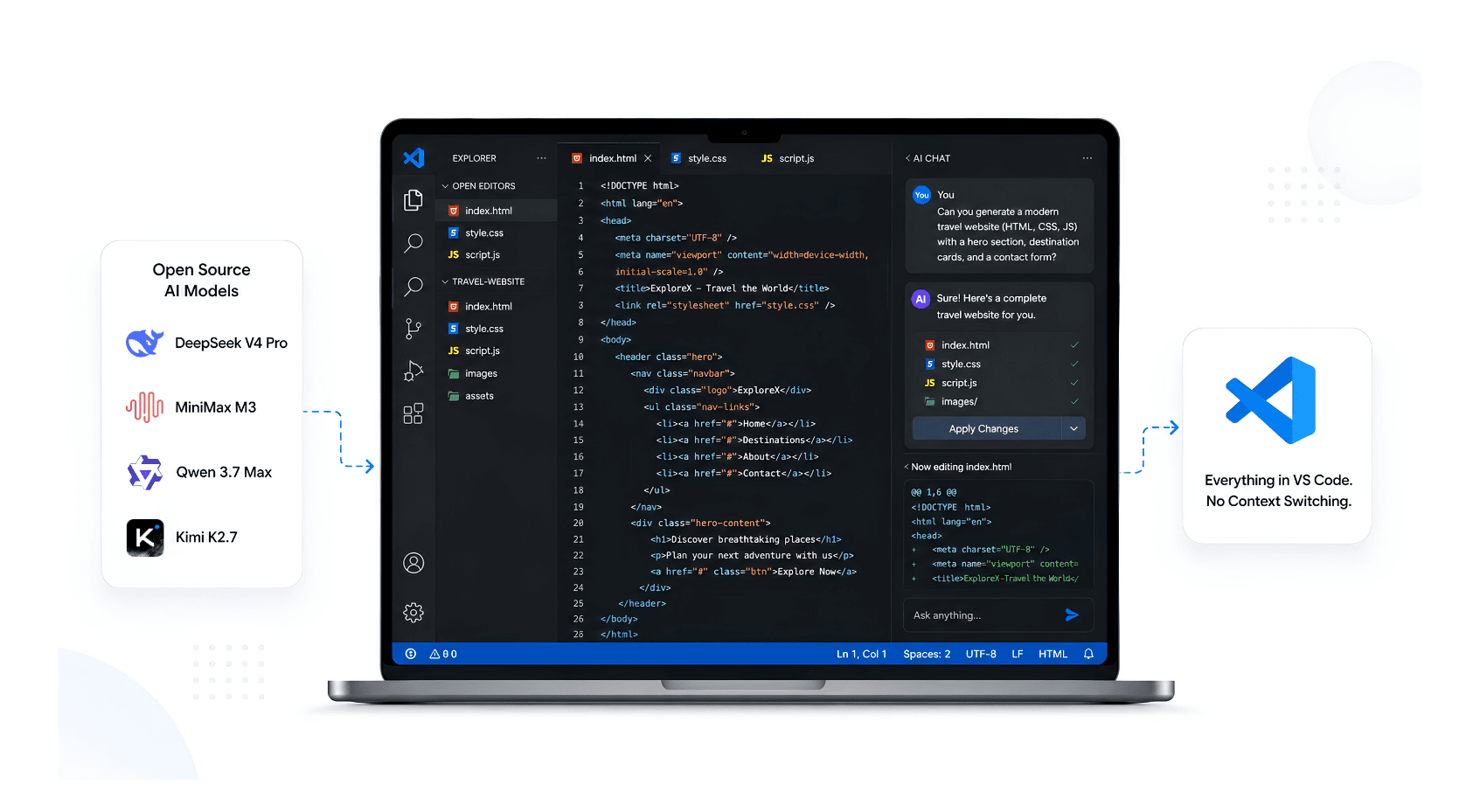
How to Use Open Source AI Models Directly in VS Code (Without Switching Tools)
Stop context-switching between your editor and AI chat tools. Here's how to run open source models like GLM-5.2, DeepSeek, and Llama 4 natively inside VS Code using Qubrid's inference API
Shubham Tribedi